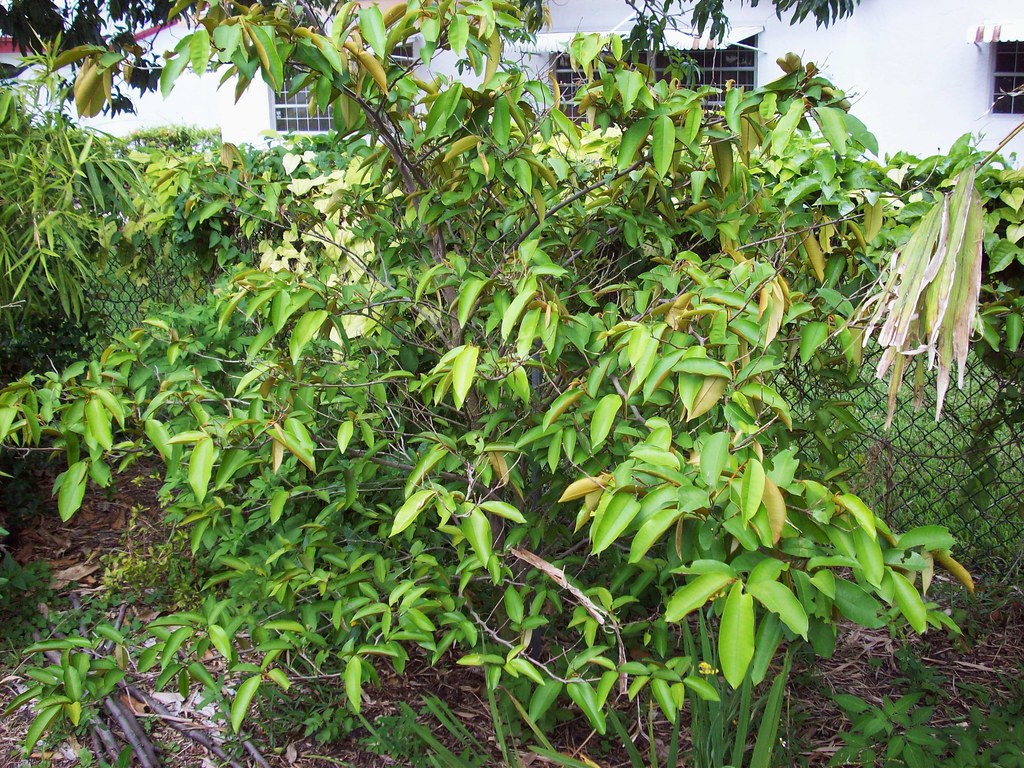
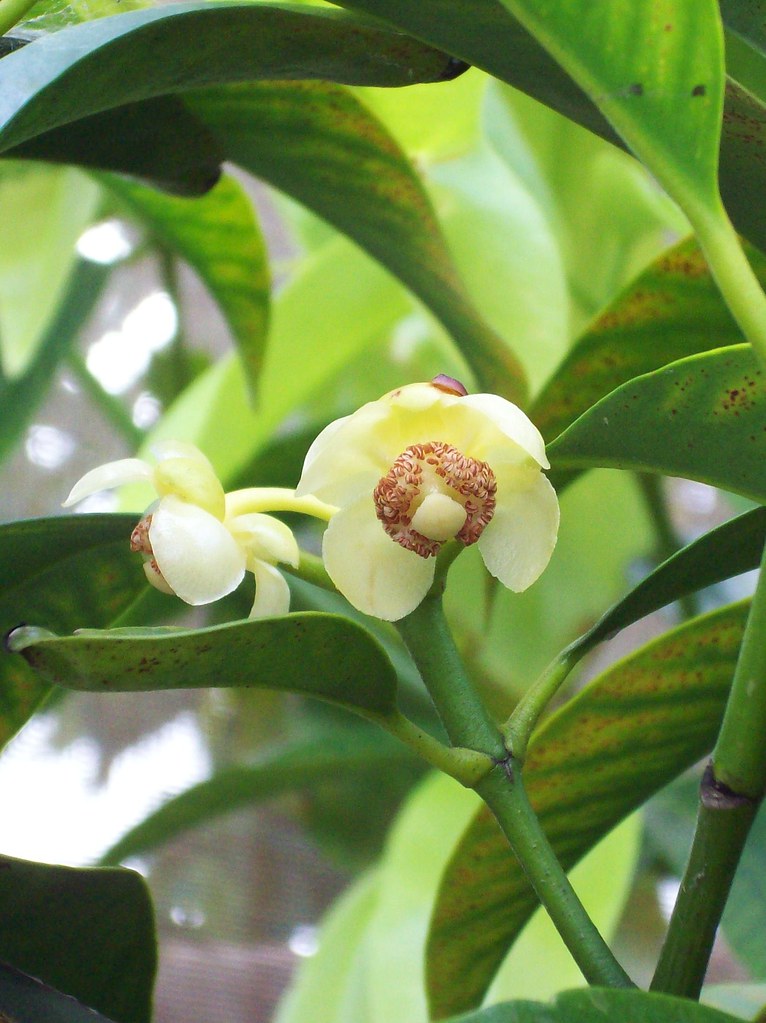
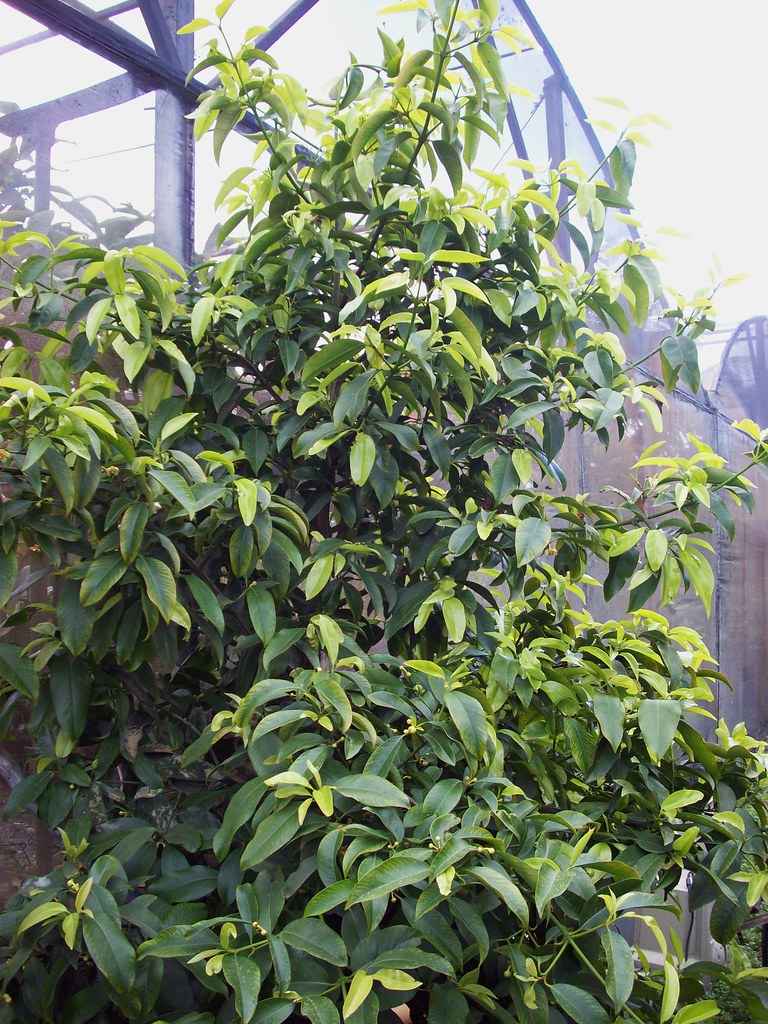
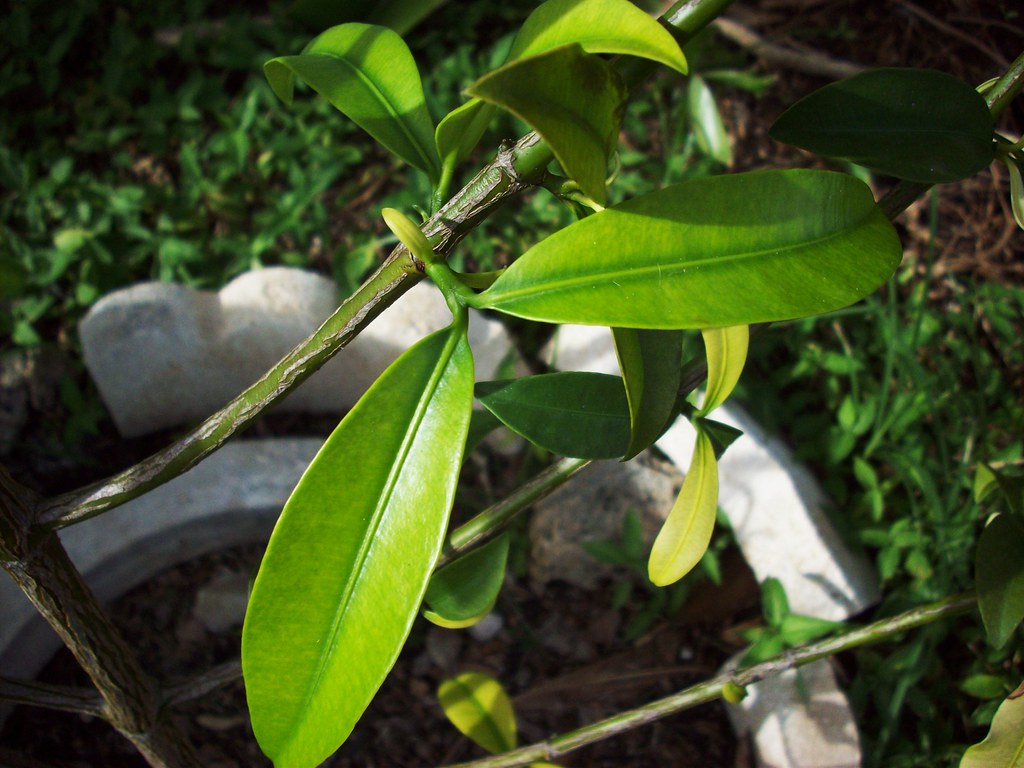
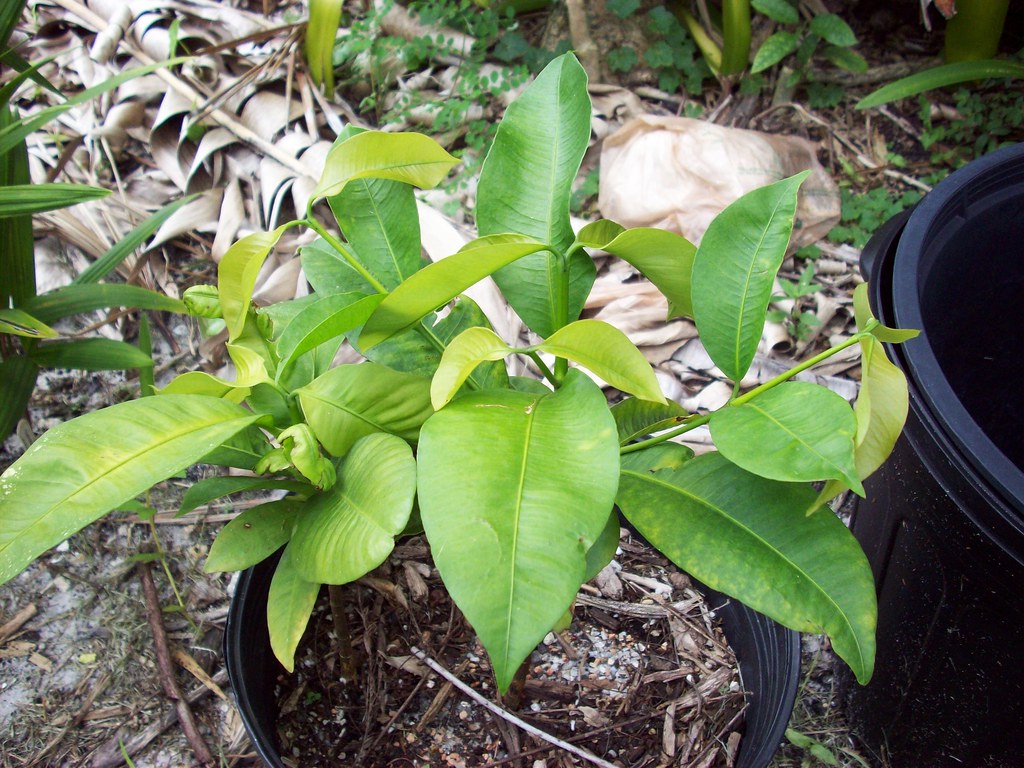
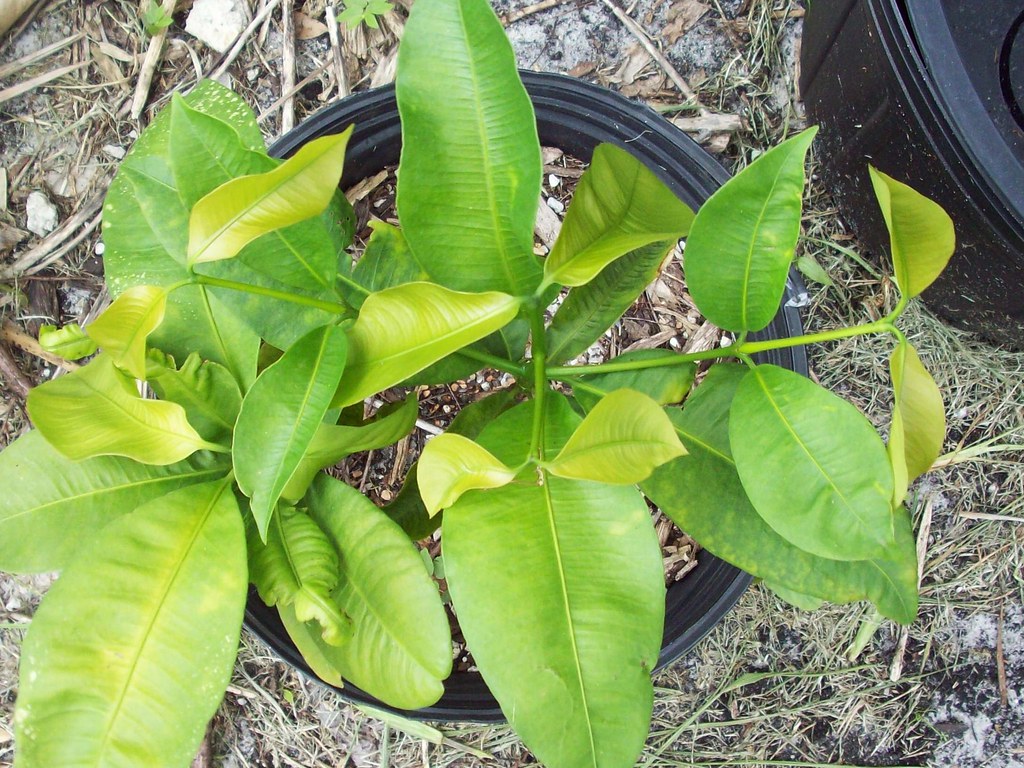
Well, after little more than a year, I have my first Musa 'Ae Ae' fruits. As you can see the fruits share the same beautiful variegation that the leaves, petioles, and trunk have. I have not tasted the Ae Ae fruits yet, but I hear they are creamy and delicious. I am looking forward to tasting them. Without further ado here are those pictures of my Ae Ae fruits!
Monday, December 19, 2011
Ae Ae Fruits
Posted by Eric Bronson at 12:01 PM 4 comments
Labels: musaceae, tropical fruits
Monday, August 8, 2011
Musa 'Ae Ae'
Last year my friend Jordan Steele of Coral Gables, gave me a pup of the most extraordinary banana the 'Ae Ae'. The Ae Ae banana is a beautiful banana plant; with variegated leaves, petioles and fruits it is simply amazing. Here are some pictures for you to enjoy and more information about this specimen.
Family: Musaceae •
Genus: Musa •
Species: 'Ae Ae' •
Country of Origin: Hawaii •
Synonyms: Sacred Banana, Koae, Hawaiian Variegated, Koa'e, Manini •
Common Names: Ae Ae •
According to Bananas.org's Wiki, A'e A'e means 'hair prematurely graying". No one knows where the Ae Ae was first found as Hawaii has no native bananas. They may have gotten the Ae Ae the same way we did, from the East. It's been in south Florida for 50 years, according to Mr. Steele (Banana's.org Wiki, 2001).
Some have found it a challenge to grow, but I have had amazing growth in just one year. I received mine from Jordan on August 30, 2010 here is a picture of me with the little pup on his website My Ae Ae's Brother As you can see, in less than a year I have a twenty foot plant with numerous pups.
My whole backyard is mulch now and it has really helped with growth. I gave it supplemental water through winter and left on all the dead leaves for added insulation. Grows well outside here in South Florida in full morning to midday sun, with heavy mulching, minimal supplemental watering and no fertilizer to date. Here is more cultural information from Banana's.org:
More information can be found about this variety and others at Bananas.orgGrows well in moderate to high humidity. Will get brown spots in low humidity. Does well under artificial lighting (standard fluorescent grow lighting). Likes to be watered regularly. Feed heavily (10-10-10) to keep green to white balance. Higher nitrogen helps to maintain greener leafs. It's been stated that Ae Ae like acid soil, but this plant has been grown successfully in highly alkaline soil and water conditions (7.0pH in Las Vegas, NV US)[Author's note 8.2pH here in South Florida]. Appears to be less susceptible to root and corm rot in higher pH. Likes a very light and well-drained soil if grown in pots. Due to its mature height, needs good ceiling clearances if grown indoors. In dry climates this plant has not demonstrated any of the difficulties that other growers in higher humidity climates have discussed. Needs lots of sun protection as the white area of each leaf will burn very easily. Does not like higher temps but has shown survivability in temps well over 105° F in a Mediterranean climate (Banana's.org Wiki, 2001).
Sources:
Banana's.org Wiki, . (2001, August 3). Musa 'ae ae'. Retrieved from http://www.bananas.org /wiki/Musa_%27Ae_Ae%27
Steele, J. (n.d.). My ae ae's brother. Retrieved from http://togofcoralgables.com/MyAeAesBrother.aspx
Musa 'Ae Ae' by Eric Bronson is licensed under a Creative Commons Attribution-Noncommercial-No Derivative Works 3.0 United States License.
Posted by Eric Bronson at 12:30 PM 3 comments
Labels: musaceae, tropical fruits
Thursday, June 30, 2011
TREC Mango Bonanza
I was at TREC Tropical Research and Education Center (University of Florida) in Homestead, Tuesday with my friend Michelle. Our friend Ian gave us a tour of the grounds and fruit tree collections. He also sent us home with a few mangoes, heh-he. You WON'T find these varieties at Publix; I hate those bland things! There are many mango cultivars to choose from each unique in flavor. I recommend you try them all. Fairchild has their Mango fest on July 9, 2011 Mango Festival at Fairchild they have an extensive tasting table where you can explore all the different flavors mangoes have to offer.....They also sell trees, chutneys and jams etc. If your in the area do yourself a favor and stop in.
Posted by Eric Bronson at 10:51 AM 0 comments
Labels: anacardiaceae, tropical fruits
Wednesday, December 29, 2010
Mango Flowers
There's a musky smell in the air. Tis' the season for the mango trees to bloom and if you haven't ever smelled a mango tree in bloom it is an odd smell. It's a musky smell, slightly of rotten eggs, but sweet at the same time. It attracts flies, beetles and wasps of all shapes and sizes this way. My trees are covered in blooms. I can't wait for this years harvest. Unfortunately these won't be ready until summer!
"Keitt" tree & flowers
"Julie" tree & flowers
"Neelum" tree & flowers
Family: Anacardiaceae •
Genus: Mangifera •
Species: indica •
Country of Origin: India •
Common Names: Keitt, Julie, Neelum •
Mango Flowers by Eric Bronson is licensed under a Creative Commons Attribution-Noncommercial-No Derivative Works 3.0 United States License
Posted by Eric Bronson at 11:58 AM 0 comments
Labels: anacardiaceae, tropical fruits
Thursday, August 19, 2010
Mangifera indica 'Julie'
Family: Anacardiaceae •
Genus: Mangifera •
Species: indica •
Country of Origin: Jamaica •
Common Names: Julie •
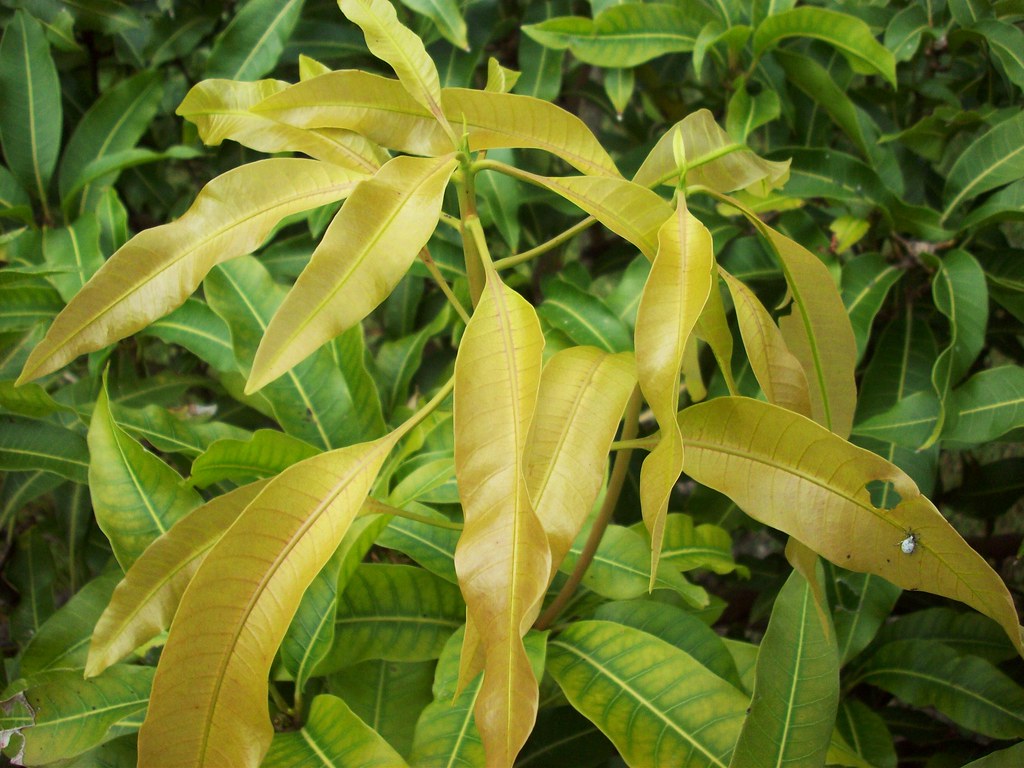
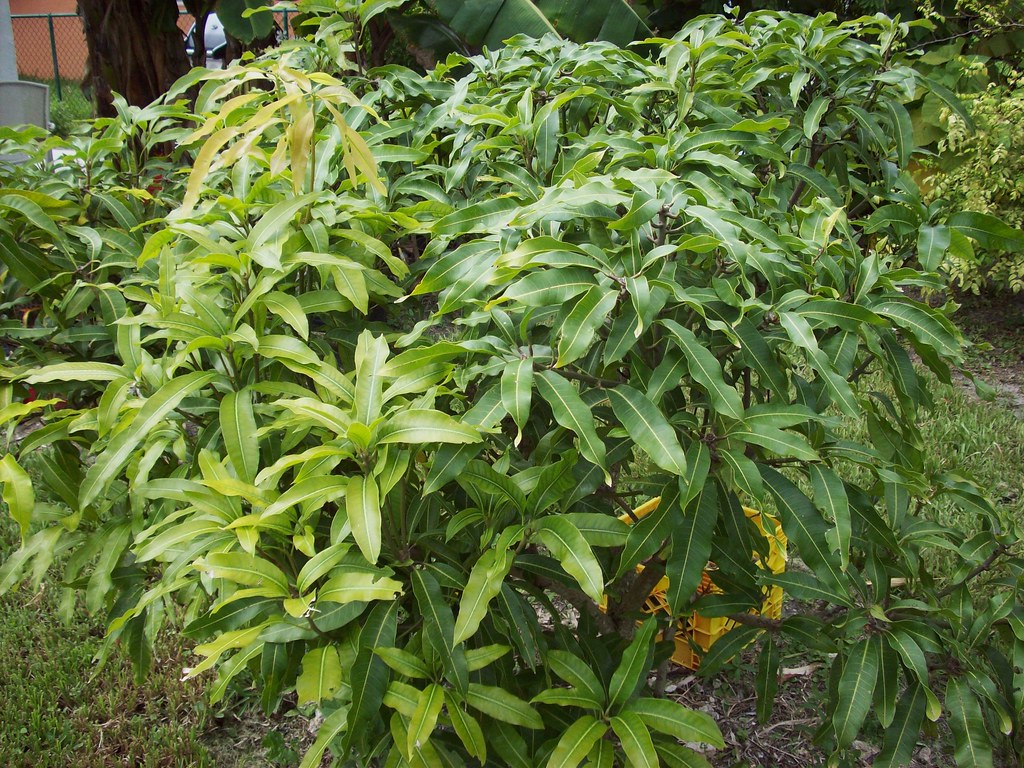
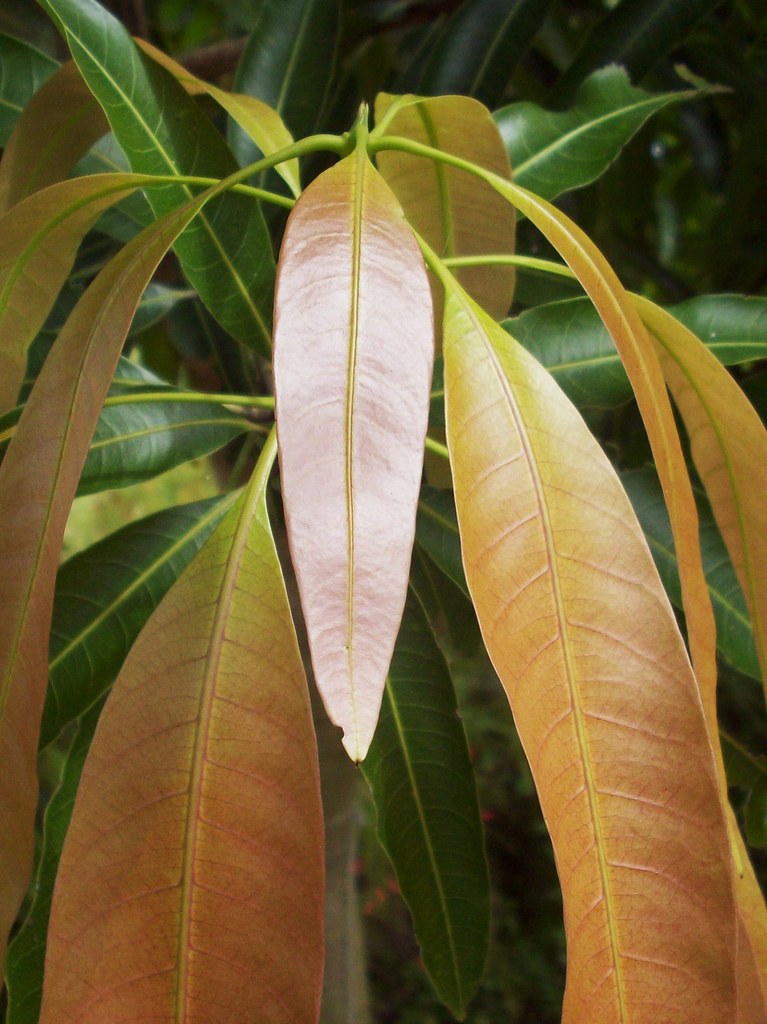
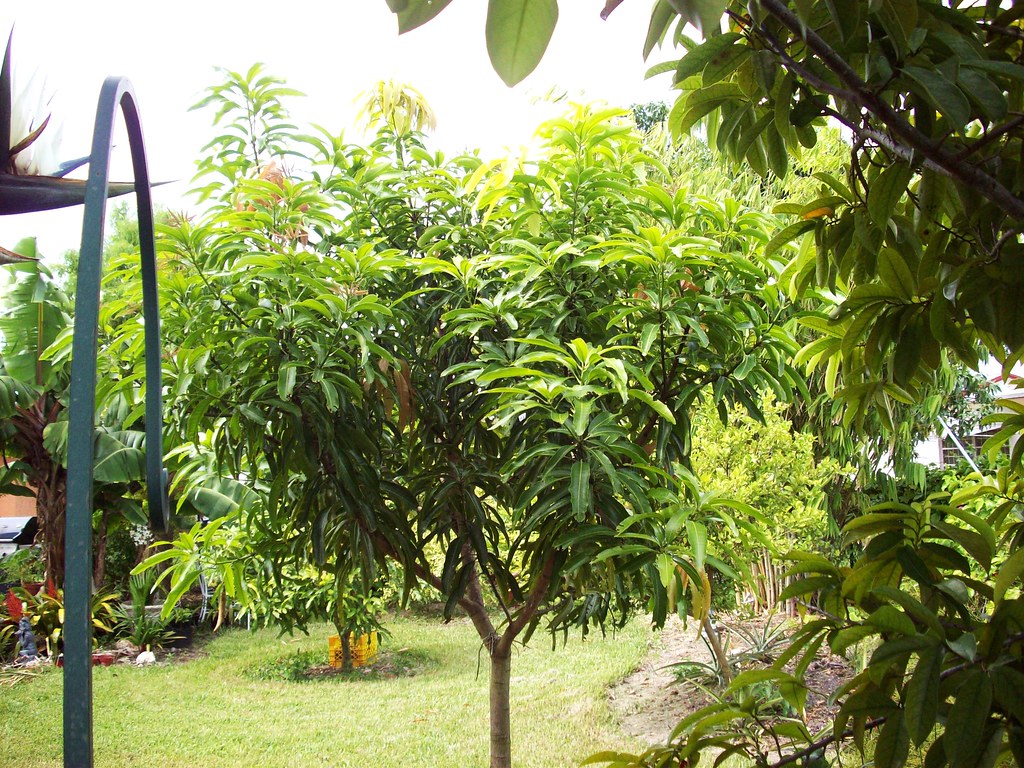
More beautiful foliage! This cultivar is a Jamaican favorite. More info in one of my older posts
'Julie' by Eric Bronson is licensed under a Creative Commons Attribution-Noncommercial-No Derivative Works 3.0 United States License.
Based on a work at www.flickr.com
Posted by Eric Bronson at 9:00 AM 0 comments
Labels: anacardiaceae, tropical fruits
Mangifera indica 'Neelum'
Family: Anacardiaceae •
Genus: Mangifera •
Species: indica •
Country of Origin: India •
Common Names: Neelum •
Had to share this beautiful foliage with you! I did a post on the fruit a few weeks back. Enjoy!
~=)
'Neelum' by Eric Bronson is licensed under a Creative Commons Attribution-Noncommercial-No Derivative Works 3.0 United States License.
Based on a work at www.flickr.com
Posted by Eric Bronson at 8:30 AM 0 comments
Labels: anacardiaceae, tropical fruits
Chrysophyllum cainito Caimito

fourth photo is from
http://www.fairchildgarden.org/
Family: Sapotaceae •
Genus: Chrysophyllum •
Species: cainito (L.) •
Country of Origin: West Indies and Central America •
Common Names: Star Apple, Golden-Leaf Tree, Caimito •
This delicious fruit is also a favorite of the June bugs as you can see by the chewed up leaves pesky little stinkers!
Caimito trees are medium to large trees, 25 to 100 ft tall (7.9 to 30.5 m) with a round to oval canopy. Branches have a weeping growth habit. The leaves are alternate, elliptic, 2 to 6 inches long (5-15 cm), slightly leathery, shiny green on the upper surface and golden-brown on the lower surface.
The flowers are generally held in clusters, arising from the leaf axils. Flowers are very small, greenish-yellow to purplish-white, tubular (5-lobed corolla), with 5–6 sepals.
Fruit may be round to oblate to ellipsoid and 2 to 4 inches in diameter (5-10 cm). The peel may be red-purple, dark-purple, or pale-green. It is smooth, glossy, and leathery. In purple fruits, the inner rind is dark purple, and in green fruits, white. The pulp is white, soft, and milky surrounding 6 to 11 seeds. The seeds are contained in rubbery seed cells, and each seed is surrounded by a gelatinous pulp. When the fruit is cut transversely, the seed cells are seen to radiate outwardly from a central core, producing a star-shaped pattern.
more info on Caimito
edis.ifas.ufl.edu/HS309
Chrysophyllum cainito Caimito by Eric Bronson is licensed under a Creative Commons Attribution-Noncommercial-No Derivative Works 3.0 United States License.
Based on a work at www.flickr.com
Posted by Eric Bronson at 8:00 AM 0 comments
Labels: sapotaceae, tropical fruits
Thursday, July 1, 2010
Garcinia spp. part 2
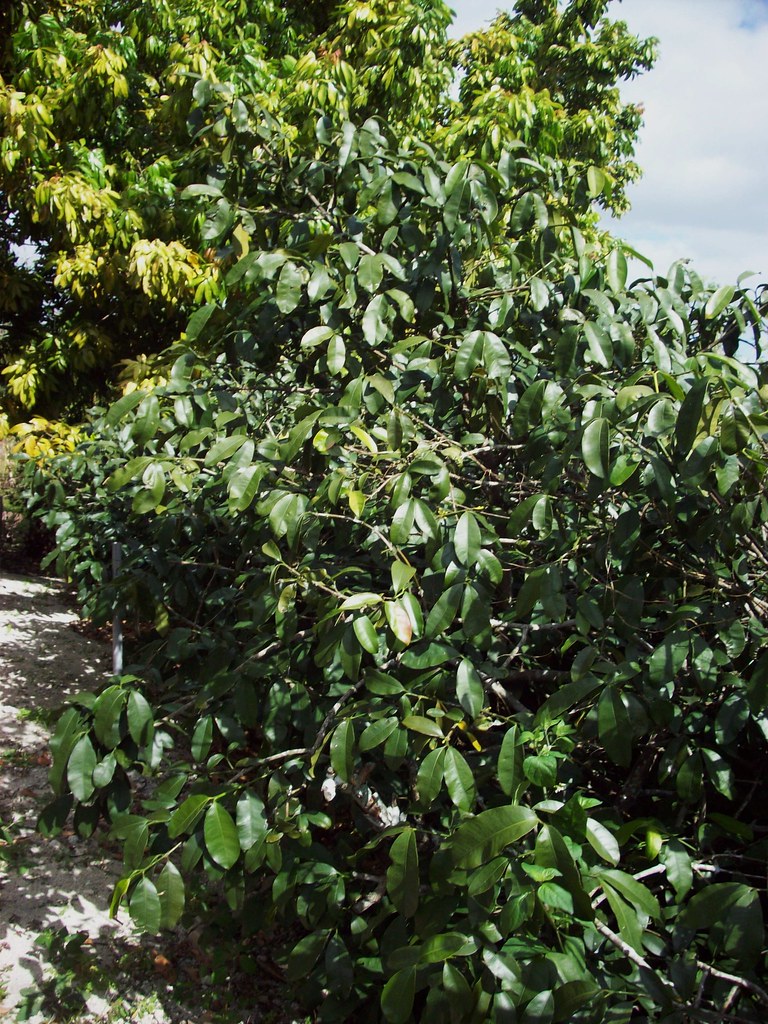
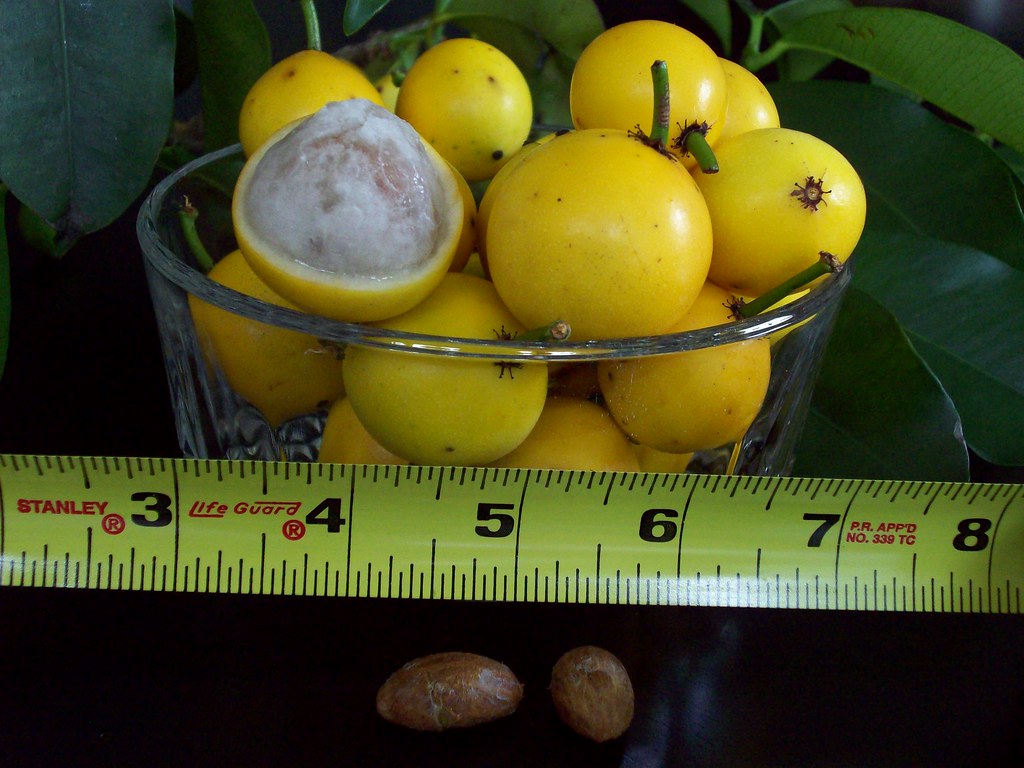
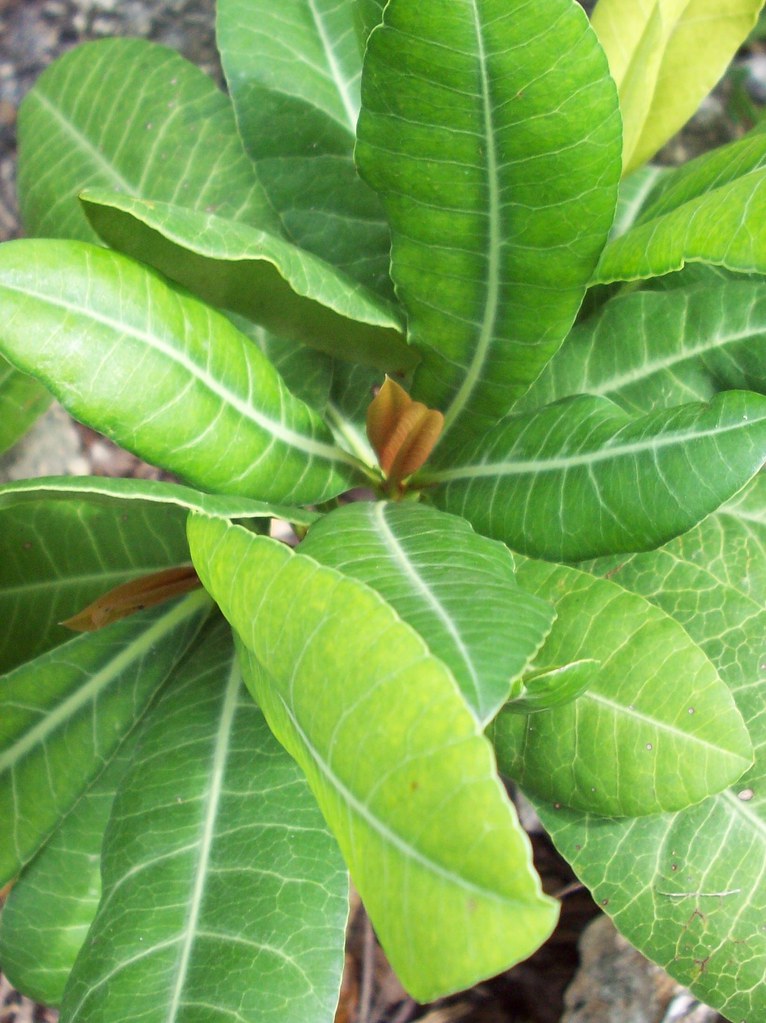
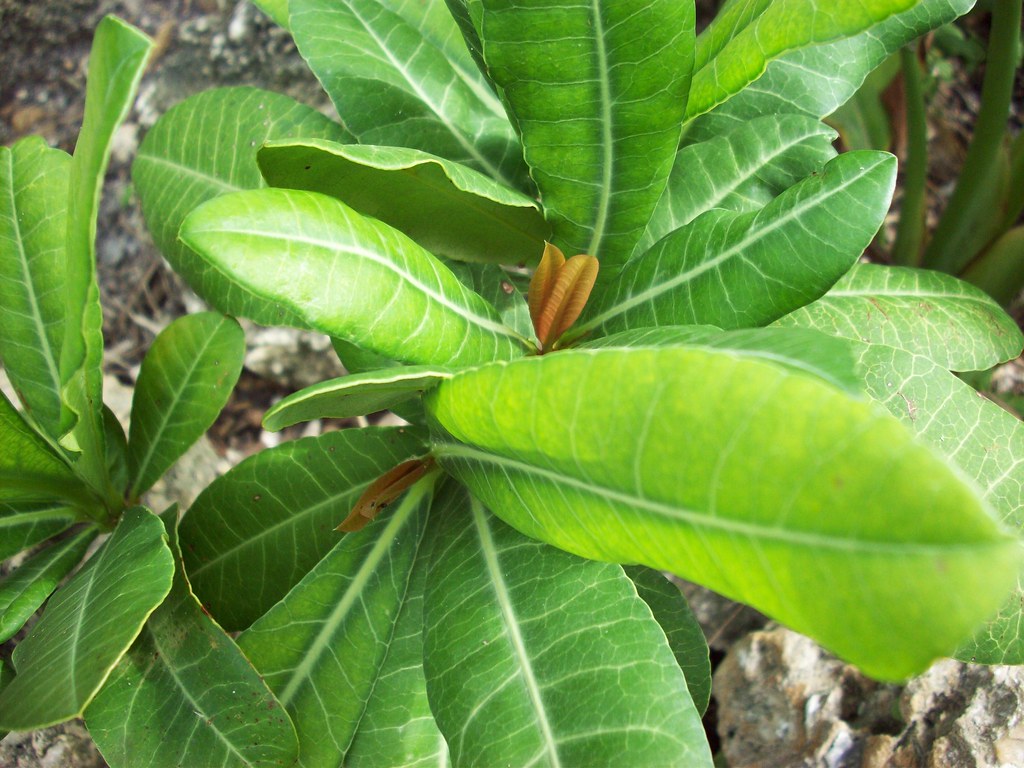
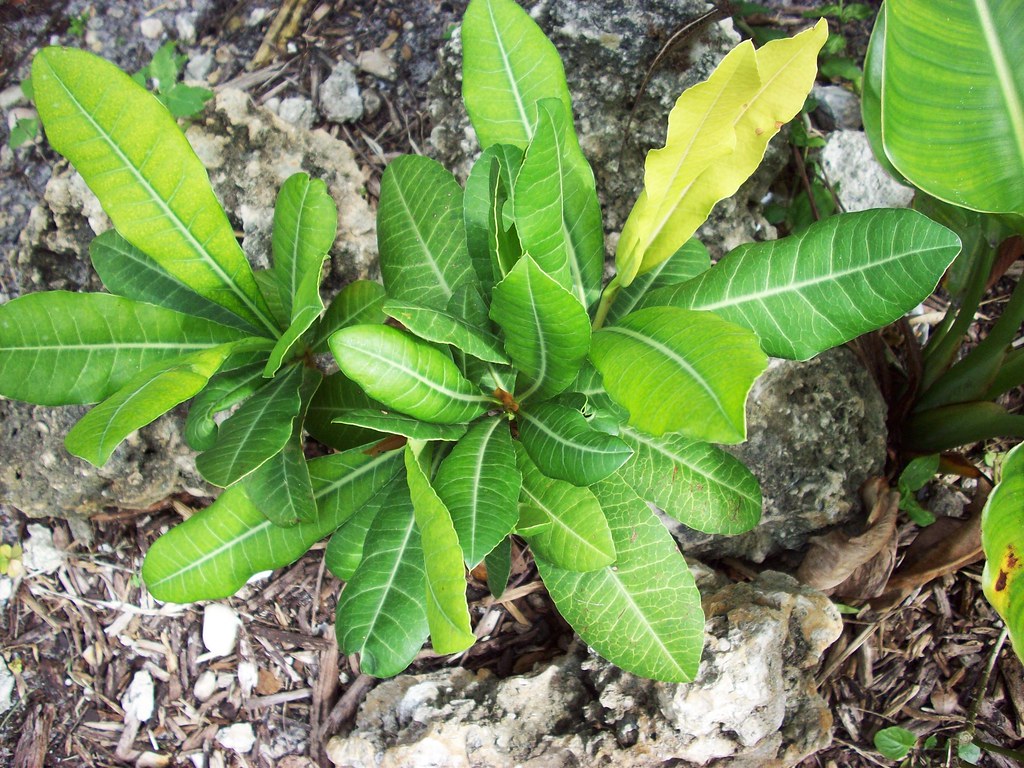
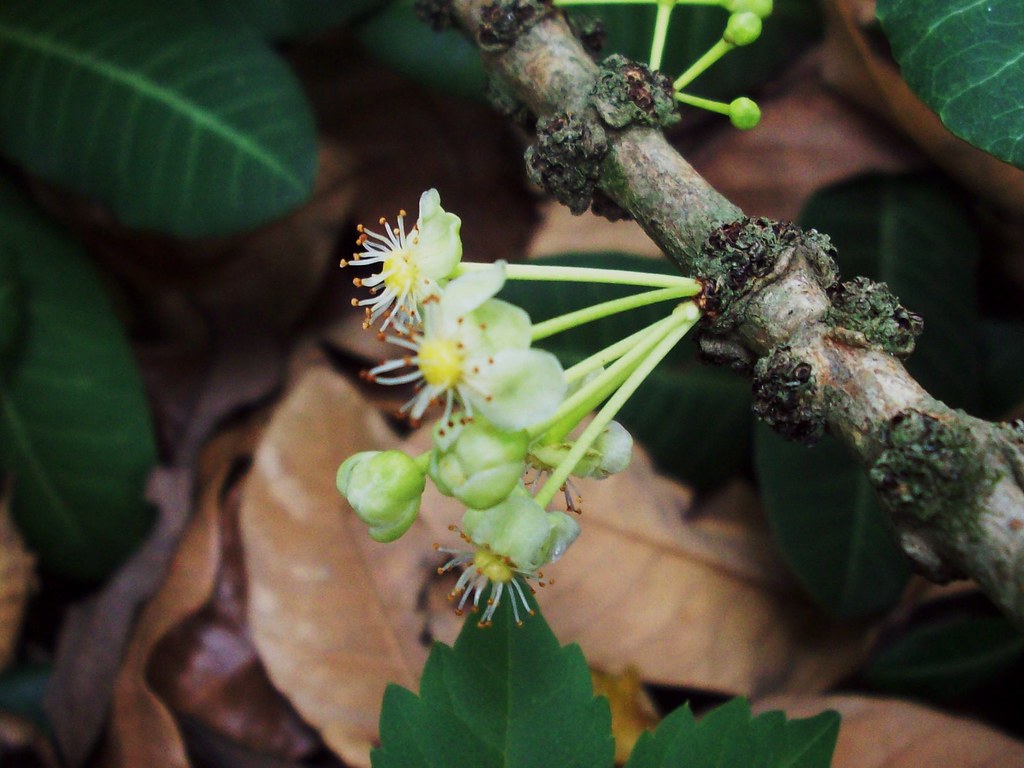
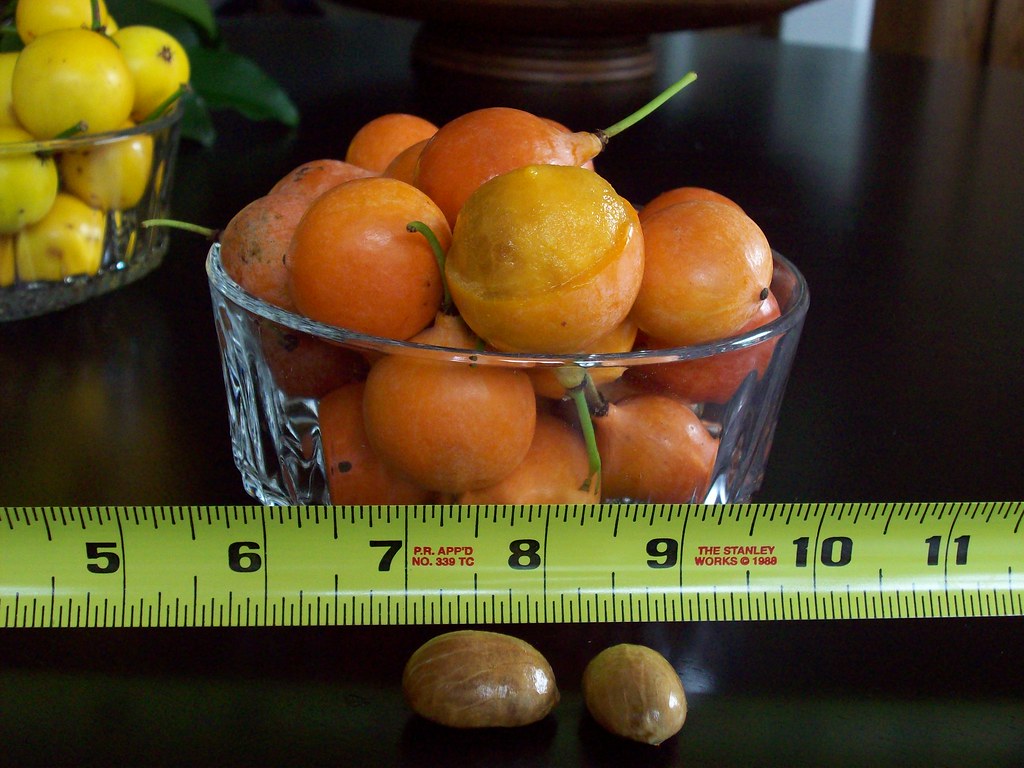
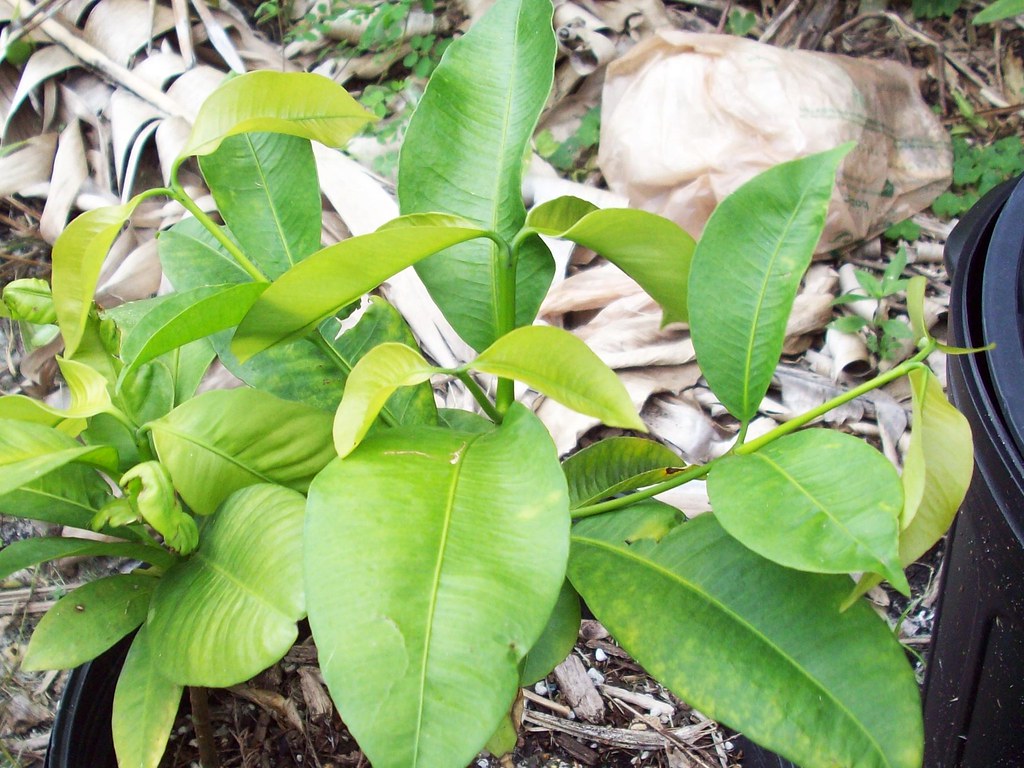
I did an earlier post on some of the Garcinia spp. that I'm growing. Here is another species, the tree and flowers are at the RFVC 208 garden and the fruit Murray C. gave me to try. It was tart and delicious. I haven't tasted a Garcinia spp. that I haven't liked yet! I've already planted the four seeds that came from the fruit. I hope every single one germinates. I've also added some new pictures to my earlier post (click on the link above) mainly pictures of the flowers. I wanted to add that there is a lot of confusion on many of the Garcinia spp. and with the small amount of information available it is doubtful that anyone is an expert on Garcinia spp. I spent a whole day making sure I have these properly identified. If you think I've made an error let me know. We only learn through our mistakes. Also, I'll be updating this post as my G. macrophylla seedlings grow and begins to bears it's fruits.
Garcinia macrophylla
Family: Clusiaceae •
Genus: Garcinia •
Species: macrophylla (Mart.) •
Country of Origin: South America •
Synonyms: Garcinia gardneriana, Rheedia benthamiana, Rheedia gardneriana, Rheedia macrophylla •
Common Names: Bacuriparí •
The Bacuriparí is native to the Amazonian lowlands, where it grows as an understory tree. The tree can grow to 30', forming an attractive, pyramidal canopy (Campbell 1983). Trees are propagated by seed and may require 7 to 10 years to come into production. Fruit are variable in shape, averaging 1 1/2" to 2" in diameter and 2" to 2 1/2" in length. The fruit have a thick, hard outer wall containing a bitter latex, as in bacurí. Inside the hard shell is a white, creamy flesh surrounding 3 to 4 large seeds. The flesh is scanty in comparison to Mangosteen or Bacurí. The Bacuriparí is outstanding because it grows and produces a significant crop in shaded conditions (Campbell 1983). The trees are also tolerant of full sun and wind exposure, making them more adaptable to varied climates than the Mangosteen. There is considerable variation in fruit quality among Bacuriparí from different regions of South America, and there may be different species involved.
excerpt from http://www.hort.purdue.edu/newcrop/proceedings1996/V3-431.html#Guttiferae
The tree is native to humid forests of Surinam and Brazil to northern Peru. The fruit is not much esteemed but widely eaten and sold in native markets. The bacuripari was introduced into Florida in 1962 and planted at the Agricultural Research and Education Center in Homestead, at Fairchild Tropical Garden and in several private gardens. One tree fruited in 1970, another in 1972, and the latter has continued to bear. Young specimens have been killed by drops in temperature to 29º to 30º F (-1.67º--1.11º C). Older trees have been little harmed by 27º to 28º F (-2.78º--2.22º C). The tree is accustomed to light-to moderate-shade. Seeds have remained viable for 2 to 3 weeks but require several weeks to germinate.
In Brazil, the tree blooms from August to November and the fruits mature from December to May. In Florida, flowers appear in April and May and a second time in August and September, and the fruits are in season from May to August and again in October and November. Some 15-to 20-year-old trees have produced 100 to 200 fruits when there have been no adverse weather conditions.
excerpt from http://www.hort.purdue.edu/newcrop/morton/bakupari_ars.html
Garcinia spp. part 2 by Eric Bronson is licensed under a Creative Commons Attribution-Noncommercial-No Derivative Works 3.0 United States License.
Based on a work at www.flickr.com
Posted by Eric Bronson at 8:00 AM 2 comments
Labels: clusiaceae, tropical fruits
Wednesday, June 30, 2010
Garcinia spp.
Garcinia intermedia
first two photos are of my G. intermedia seedling
large shrub-like specimen G. intermedia @ the RFVC 208 garden
female? (not a 100% on this) flowers of G. intermedia @ the RFVC 208 garden
G. intermedia fruits, seeds & leaves.
Family: Clusiaceae •
Genus: Garcinia •
Species: intermedia (Pittier)Hammel •
Country of Origin: Central & South America •
Synonyms: Rheedia edulis •
Common Names: Lemon Drop Mangosteen, Mameyito •
I transplanted this last year and it has struggled every since. I feel terrible, it looks like Charlie Brown's Christmas tree! It also had a magnesium deficiency which I've since taken care of. You can see the deeper green coming back. This fruit reminds me of a childhood favorite Lemonhead™ candy. I can't wait till it fruits. It could be a while because it is not happy with me!
Update 2-16-2009 I have three more seedlings growing now!!!
The elegant, erect tree, ranging up to 100' (note from Eric: I'm not sure the ultimate height for this tree is correct as information varies, the one at the RFVC 208 garden is barely 10' high, so for now I'll stick with J. Morton, but I'd venture to say it is more like 20' or 30' high ultimately) has copious gummy, yellow latex and opposite, short-petioled, thick, leathery, elliptic-oblong or elliptic-lanceolate leaves, 3 3/16" to 6" long, 3/4" to 2" wide, or much larger, with numerous lateral veins conspicuous on both surfaces; dark-green above, pale or brownish on the underside. Young foliage is reddish. The small, greenish-white or ivory flowers, densely clustered below the leaves, are 4-petalled, the male with 25 to 30 stamens, the perfect with 10 to 12.
The fruit is oval or oblong, 3/4" to 1 1/4" long, smooth, orange or yellow, the thin, soft skin easily peeled. There is a little flesh, sweet or acid, adhering to the 1 or 2 seeds.
excerpt from http://www.hort.purdue.edu/newcrop/morton/bakupari_ars.html
Garcinia livingstonei
first three photos are of my G. livingstonei seedlings
female flowers of G. livingstonei @ the RFVC 208 garden
male flowers of G. livingstonei @ the RFVC 208 garden
G. livingstonei fruits & seeds
Family: Clusiaceae •
Genus: Garcinia •
Species: livingstonei (T. Anderson) •
Country of Origin: Africa •
Synonyms: •
Common Names: Imbe, African Mangosteen •
All these Garcinia spp. are grown from seeds. They start off real slowwwwwwwwww, but they're growing good now. Another tasty Garcinia sp. Definitely has a lemony flavor like most of these species described here.
Even without their fruits, these highly ornamental trees are good to have around. Seen in profile, they frequently divide near the ground into three or four upright, outward-curving trunks that carry short, stiff, lateral branches. They can reach 30' in height, but are normally much less. The new shoots grow in whorls (verticils) of three and emerge at an acute angle from the stem, giving the tree its characteristic asymmetry and crooked form.(1) Leaves usually 3 in a whorl (may be 4 or opposite), variable in shape but usually egg- or lance-shaped, generally 2 1/2"–4 1/2" × 1 1/4"–2 1/4" , blue-green with whitish veins, waxy. Flowers in groups of 5–15 in leaf axils on old wood, greenish, whitish or yellow, scented, male and bisexual flowers of different structure.(2)
The fruit looks like a small plum: orange in color and round or ovoid in shape but it has a point at the bottom, 3/4" to 1 1/4" long and about the same in diameter. The skin—thin, smooth, glossy, and leathery tough—separates easily from the flesh. The pulp itself is yellow and watery, with a pleasing flavor—sweet, and not unlike a perfect peach. In the center are one or two seeds which, unlike its relatives, are not reported as eaten.(1)
A traditional food plant in Africa, this little-known fruit has potential to improve nutrition, boost food security, foster rural development and support sustainable land care. It is mainly grown as an ornamental fruit, but is sometimes eaten. The juice is known for staining very badly. Mostly eaten fresh, it is also used in drinks. It can be grown in southern Florida. Both a male and female plant are needed in order to obtain fruit, although both sexes can be grafted onto the same plant to achieve the same effect.(3)
excerpts from
(1)Lost Crops of Africa Volume III
(2)http://www.plantzafrica.com/plantefg/garcinliving.htm
(3)http://en.wikipedia.org/wiki/Garcinia_livingstonei
Garcinia madruno
first three photos are of my small G. madruno seedlings

last two photos G. madruno fruits © Copyright Smithsonian Tropical Research Institute 2003-2006
Family: Clusiaceae •
Genus: Garcinia •
Species: madruno (Planch. & Triana) •
Country of Origin: Costa Rica, Peru •
Synonyms: Rheedia acuminata, Rheedia madruno •
Common Names: Charichuela, Madroño •
I got these seeds from Bill Whitman before he passed away. "Mr. Whitman was a founder of the Rare Fruit Council International, based in Miami, and was its first president, from 1955 to 1960. "(1) His legacy lives on with these plants and I'm sure hundreds of others. They started slow but they're taking off this year. This fruit tastes like lemony cotton-candy. It's possibly the best fruit I've ever tasted. I can't wait for it to fruit!!!!
The tree is erect, lush, compact, with pyramidal or nearly round crown, 20' to 65' high, and has much gummy yellow latex. The opposite leaves are elliptic to oblong, wedge-shaped at the base, rounded or pointed at the apex, 2 3/8" to 8" long, 3/4" to 3" wide; dark green above, paler beneath, with numerous veins conspicuous on both surfaces and merging into a thick marginal vein. The fragrant male and female flowers are borne on separate trees in clusters of up to 14 in the leaf axils; have 4 re-flexed, pale-yellow petals; the male, 25 to 30 light-yellow stamens.
The fruit is round or ellipsoidal, sometimes with a prominent nipple at each end; 2" to 3" in long, with thick, leathery, warty, greenish-yellow rind containing a deep-yellow, resinous latex. The white, translucent, juicy, sweet-acid, aromatic pulp adheres tightly to the 1 to 3 ovate or oblong seeds which are about 3/4" in long.(2)
excerpts from
(1)http://www.nytimes.com/2007/06/04/us/04whitman.html
(2)http://www.hort.purdue.edu/newcrop/morton/bakupari_ars.html
My friend Chris Hind has some great photos of Garcinia spp. at his site here
Lets figure out the Garcinia's
last updated on 05-31-2009
Garcinia spp. by Eric Bronson is licensed under a Creative Commons Attribution-Noncommercial-No Derivative Works 3.0 United States License.
Based on a work at www.flickr.com
Posted by Eric Bronson at 8:00 AM 0 comments
Labels: clusiaceae, tropical fruits