


These are the Jackfruit (Artocarpus heterophyllus) seeds that I started back in November. I did a post in January about starting these seeds, you can read that post here http://ilikerareplants.blogspot.com/2009/01/jackfruit-seedlings.html Back to the seedlings though, they are about 24 inches tall with a nicely developed root system. I dug a deep hole about 3 feet in diameter and 3 feet deep and soaked the hole.. I mixed all of that material in my wheelbarrow then built the hole back up to a proper depth and planted my seedlings. I gave each seedling a nice shower of water and, using bamboo stakes from my bamboo plants I secured each little plant. I planted three trees in a nice triangle shape that should look really nice as the trees mature and, I hope to increase fruit set by having more than one tree. I'll be feeding them an organic fertilizer once they get established and I plan to mulch, too. I hope to have fruits in less then five years, let's see how well I can grow!!! I'll be documenting their progress with photos.
Sunday, March 22, 2009
Jackfruit Seedlings Planting Out
Saturday, January 3, 2009
Jackfruit Seedlings
These are seeds that I started in late November all growing vigorously. Thanks to my friend Chris H. who sent me some seeds for free what a nice guy! It looks like all but one germinated and it may sprout yet. I plan to use the six plants that show the most vigorous growth to plant out in the yard, then I can top work (a form of grafting) them in the future if necessary(*see below). Here's a little more on propagation.
You see there are two ways to propagate Jackfruit
Seeds
Pros:
• A simple and easy method of reproducing the trees.
The tree is generally deep rooted with a strong taproot facilitating firm anchorage, and greater resistance to drought as well as high wind.*This is very important in Florida.
Cons:
• The characteristics of fruits produced by the seedling trees cannot be guaranteed, and are not necessarily the same as those of the mother tree.*This would be my reason for grafting.
• The time taken by seedling trees to reach fruit-bearing age is usually longer than for those trees propagated by vegetative methods.
• The trees grow taller than those propagated by vegetative methods, which is a constraint in management and harvesting.
Vegetative propagation
• Vegetative propagation can be carried out by different methods. Veneer and epicotyl grafting are commonly practiced in jackfruit in Asia (Haq, 2006). Details are described in Section 5.
• Fruiting and fruit quality of vegetatively propagated trees are the same as those of the mother tree.
• Vegetative propagation is particularly favored in Thailand.
Pros:
• The fruit quality of the new tree is assured; it will be the same as the mother tree. *This may be necessary to have the best quality fruit.
• The tree reaches fruit-bearing age sooner than in seed-propagated trees.
• The trees remain relatively shorter in stature, which makes management and harvesting easier.
Cons:
• The trees are often shallow rooted. *That will work well in South Florida, seriously though this could be a problem.
• Trees tend to be dwarf and to produce branches at a low level, which results in lower quality timber with a shorter trunk.(1)
Ok, so you see what I've underlined. And I've given an explanation of why this would be a pro or con here in South Florida. So to get the best of both worlds I plant out these seedlings. Then, if these seedlings end up producing inferior fruit or are slow to produce, I will graft onto to the already established seedlings, with their long taproots, with scions from more esteemed cultivars.
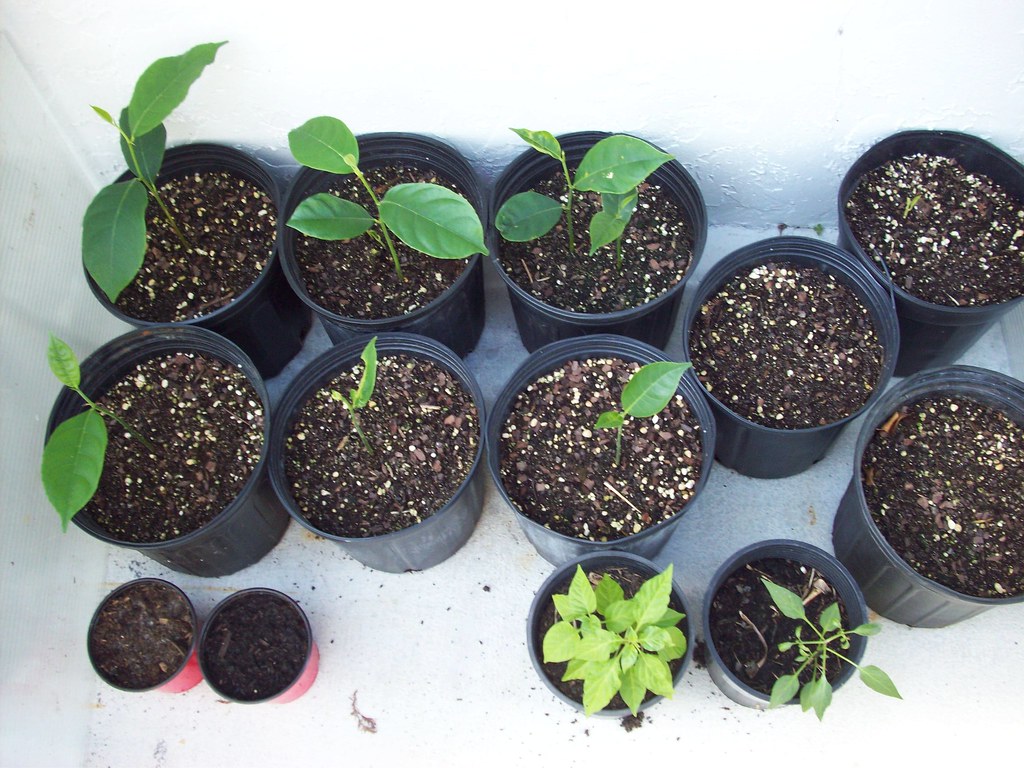
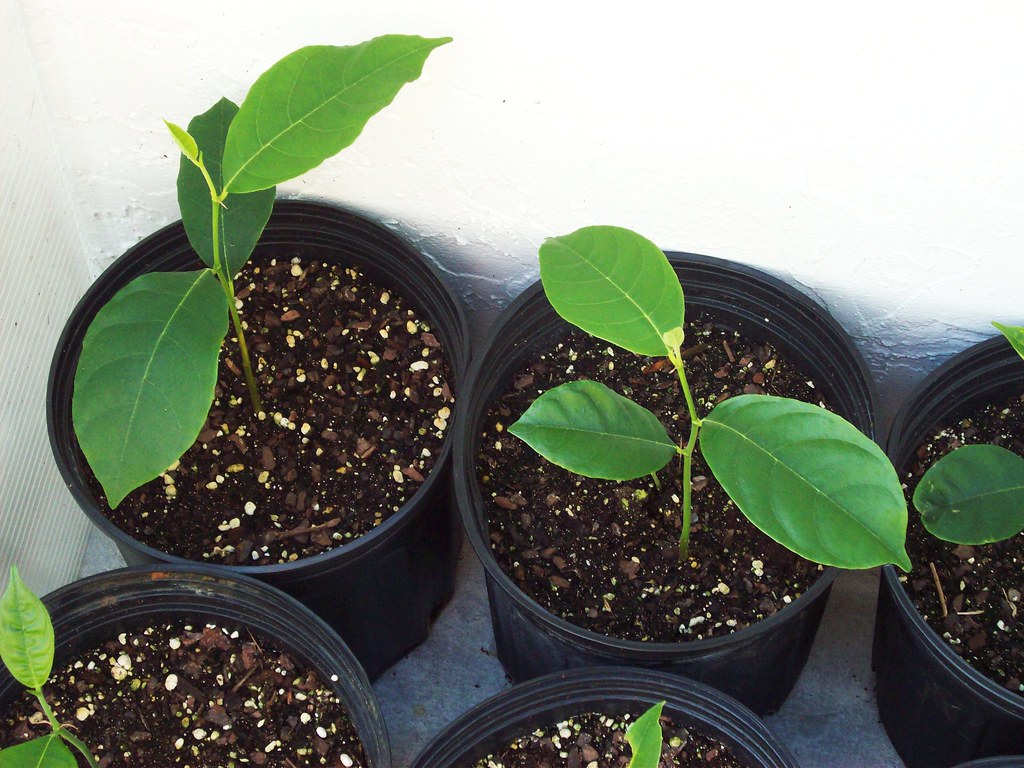

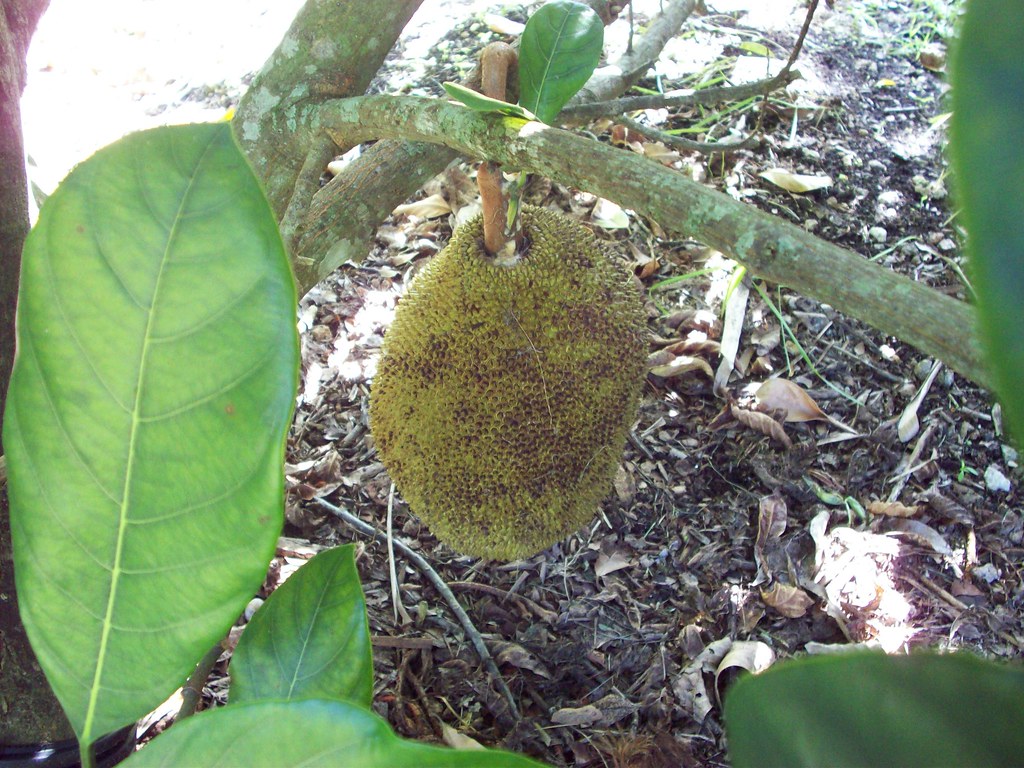 This Photo Taken 11-01-2008 @ RFVC 208 Garden
Family: Moraceae •
Genus: Artocarpus •
Species: heterophyllus •
Country of Origin: India, Bangladesh, Nepal & Sri Lanka •
Common Names: Jackfruit, Jak-fruit, Jak, Jaca •
The largest tree borne fruit in the world. This is a large tree that can reach 30 to 70 feet high. Although, I doubt it will get that big here in South Florida. The edible arils(2) taste like Bubble Yum™ bubblegum and bananas. I had one but it died, I'm a terrible gardener, ha-hah. I think these seedlings are going to do well stay tuned for updates. And hopefully, I won't have to wait long for fruit, most sources say that this species is precocious, it may start fruiting after three to four years!(3)
(1)International Center for Underutilized Crops: Jackfruit Manual
(2)http://en.wikipedia.org/wiki/Aril
(3)JackFruit Growing In Florida University of Florida

Jackfruit Seedlings by Eric Bronson is licensed under a Creative Commons Attribution-Noncommercial-No Derivative Works 3.0 United States License.
Based on a work at www.flickr.com