


Family: Orchidaceae •
Genus: Prosthechea •
Species: cochleata var. triandra (Ames) •
Country of Origin: Native to Florida •
Common Names: Cockleshell Orchid, Clamshell Orchid •
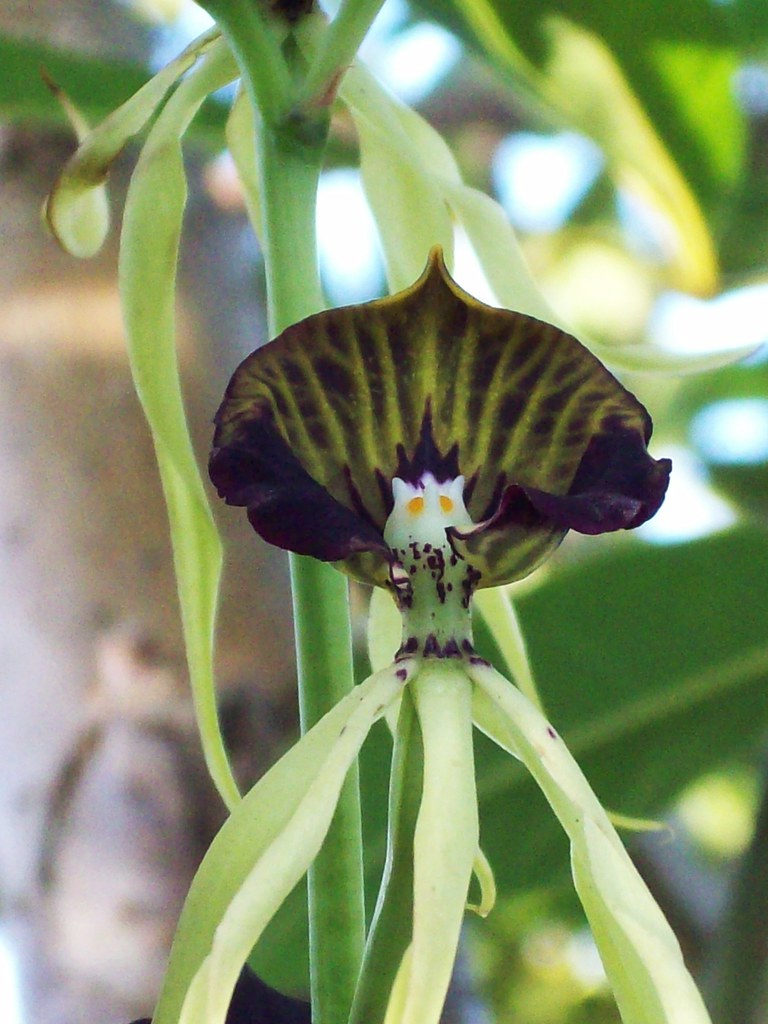
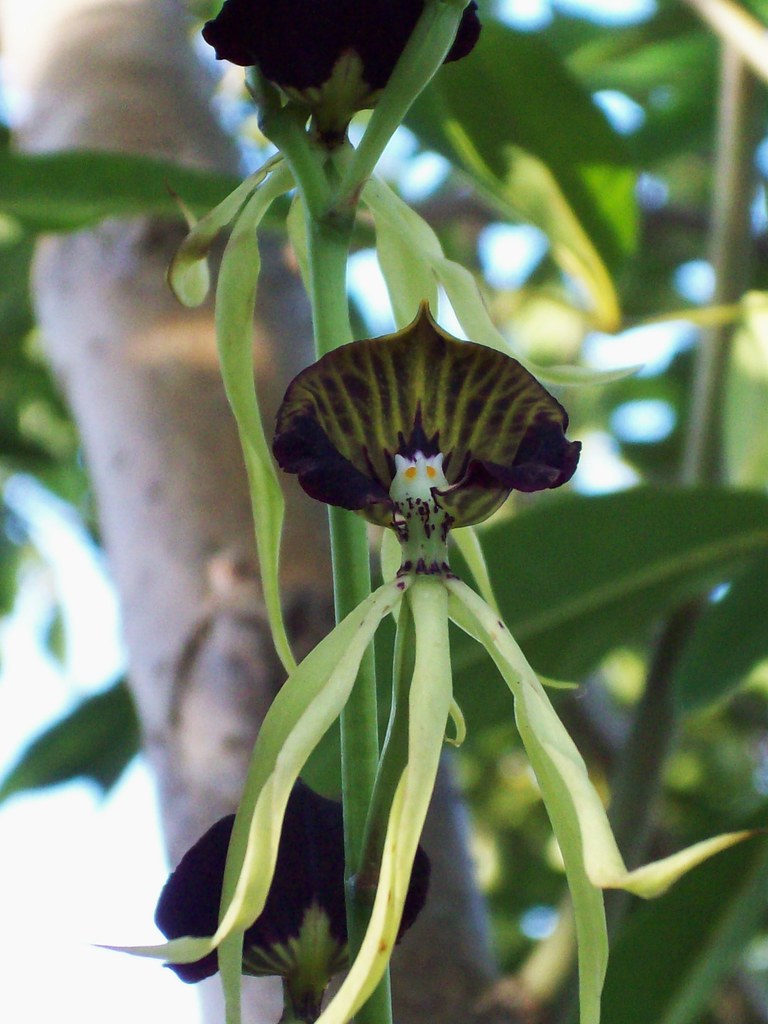
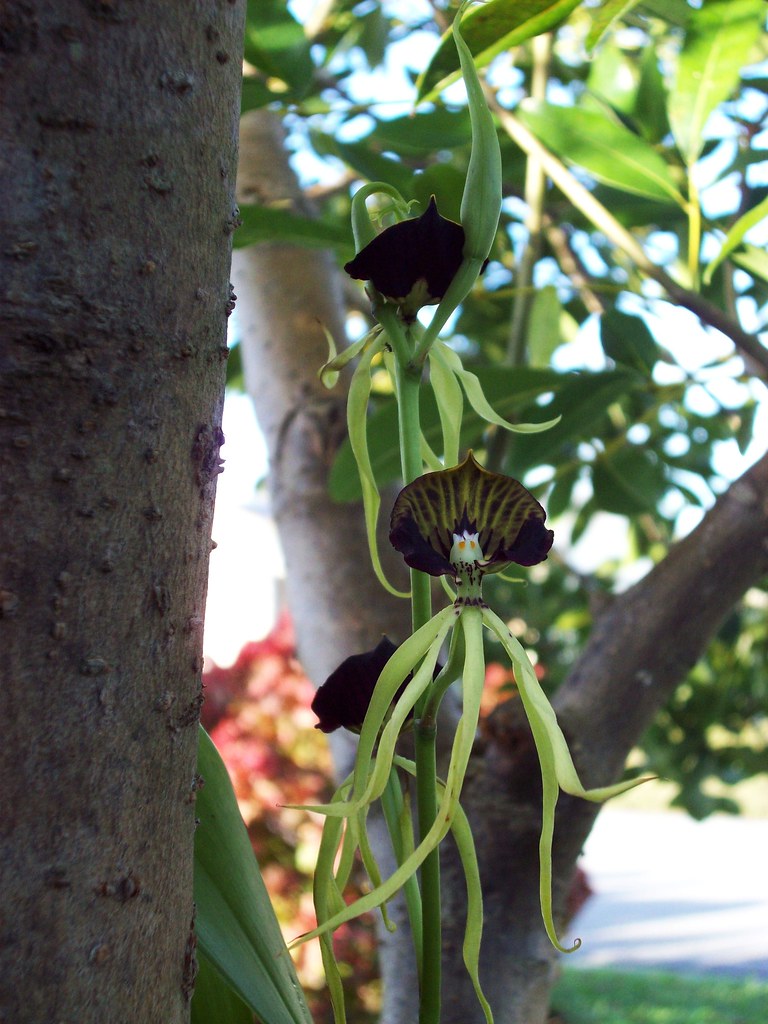
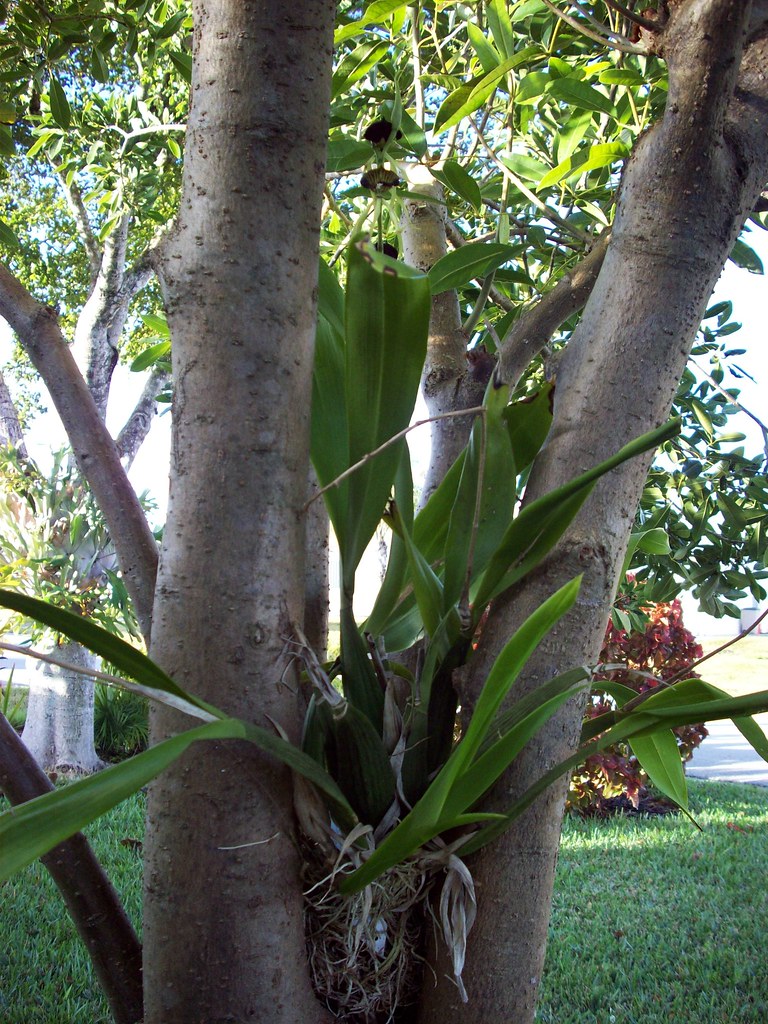
This is one of the orchids I'm naturalizing on a tree outdoors, since it is a native to Florida it won't have any problem getting adjusted. As you can see it is already flowering. It has very unusual flowers with a modified lip and twisted hanging petals and sepals. Now that it is established I won't give it any extra care it will flourish on its own. It should form a nice clump. Unfortunately, this species is endangered in Florida(1) due to over-development and habitat loss.
This specimen was purchased from a reputable dealer not collected in the wild. Zones 9-11
P. cochleata is an epiphytic orchid found growing attached to trees in swamps throughout Central America, the West Indies, Colombia, Venezuela, and southern Florida. In Florida, where P. cochleata is listed as endangered, many wild individuals of this species are of a variation that has three anthers, which contain masses of pollen. In most of its range, P. cochleata commonly has only one anther. This has led some taxonomists to conclude that individuals of P. cochleata in Florida may all be descended from a single plant, whose tiny seed may have been transported there by a storm or a bird.(2)
Plants to 60 cm. Stems: pseudobulbs slightly spaced, ovoid to ellipsoid, usually elongate, flattened, 3–15 × 1–3.5 cm. Leaves 1–3, oblong-lanceolate to linear-lanceolate, 5–40 × 1–6 cm. Inflorescences racemes, rarely paniculate, pedunculate, elongate, loosely few-flowered, to 45 cm, base with 1 or 2 spathes. Flowers not resupinate, successive, usually 3–4 open at a time, sometimes with capsules present, green to yellowish green with a few purplish spots near base; sepals and petals similar, hanging, twisted, linear-lanceolate, 25–35 × 3–6 mm; lip deep purple, orbiculate-cordate, concave, 1.2–2.3 × 1.5–3 mm, base whitish marked with conspicuous purple veins, calli 2, yellowish, cushionlike, apex sharply mucronate; anthers 3, middle anther with 4 pollinia, laterals with 2 each, orange; column short, stout, 6–10 mm, apex 5-toothed. Capsules 2–4 × 0.8–1.5 cm.
Flowering Oct--Mar; fruiting Nov--May. In hammocks and cypress swamps, on trees and rocks; 0--30 m; Fla.
The autogamous, 3-anthered Prosthechea cochleata var. triandra is the only variety found in Florida (Broward, Collier, Miami-Dade, Lee, Martin, Monroe counties, and Florida Keys), probably because of the absence of a pollinator. Throughout the rest of the distribution of the species, 3-anthered, abnormal individuals seldom occur, and no populations have been reported. The 1-anthered var. cochleata occurs in Mexico, West Indies, Central America, and northern South America.(3)
(1) http://florida.plantatlas.usf.edu/Plant.aspx?id=2720
(2) http://www.usbg.gov/plant-collections/conservation/Encyclia-cochleata.cfm
(3) http://www.efloras.org/florataxon.aspx?flora_id=1&taxon_id=242102289
Prosthechea cochleata var. triandra by Eric Bronson is licensed under a Creative Commons Attribution-Noncommercial-No Derivative Works 3.0 United States License.
Based on a work at www.flickr.com
Saturday, January 8, 2011
Prosthechea cochleata var. triandra

Wednesday, December 29, 2010
Mango Flowers
There's a musky smell in the air. Tis' the season for the mango trees to bloom and if you haven't ever smelled a mango tree in bloom it is an odd smell. It's a musky smell, slightly of rotten eggs, but sweet at the same time. It attracts flies, beetles and wasps of all shapes and sizes this way. My trees are covered in blooms. I can't wait for this years harvest. Unfortunately these won't be ready until summer!
"Keitt" tree & flowers


"Julie" tree & flowers


"Neelum" tree & flowers


 Family: Anacardiaceae •
Genus: Mangifera •
Species: indica •
Country of Origin: India •
Common Names: Keitt, Julie, Neelum •
Mango Flowers by Eric Bronson is licensed under a Creative Commons Attribution-Noncommercial-No Derivative Works 3.0 United States License